
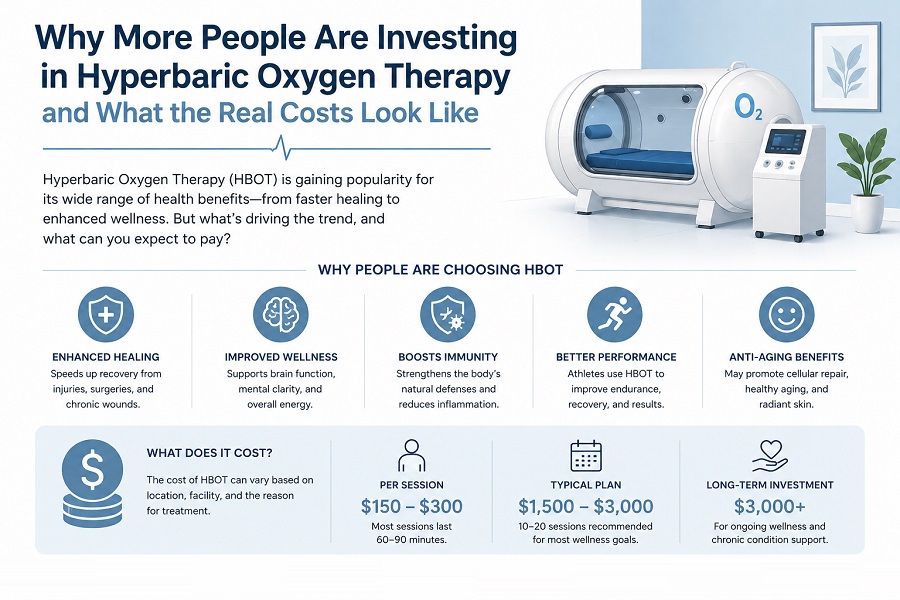
From Elite Recovery Tool to Mainstream Health Investment
Not long ago, hyperbaric oxygen therapy was something most people only heard about in documentaries about deep-sea divers, military medicine, or specialised hospital treatment. Outside of those circles, very few people knew what a hyperbaric chamber looked like, how the therapy worked, or why physicians were using pressurised oxygen as part of serious treatment protocols.
That has changed.
Over the last decade, hyperbaric oxygen therapy, often referred to as HBOT, has quietly moved into wider conversations around recovery, longevity, neurological support, sports rehabilitation, and patient-led wellness. Professional athletes talk about it. Functional medicine clinics offer it. Recovery centres include it alongside physical therapy. Even patients researching chronic inflammation, post-surgical healing, and cognitive performance are beginning to ask whether HBOT could become part of their long-term health strategy.
With that growing interest comes one practical question almost everyone asks early in the process:
How much does it actually cost?
The answer is not always straightforward.
Hyperbaric oxygen therapy can range from a short-term clinic investment to a long-term equipment purchase, and understanding those costs requires looking beyond the session price alone.
Why Hyperbaric Oxygen Therapy Costs Can Vary So Widely
Unlike a standard massage, consultation, or fitness membership, HBOT pricing depends on a combination of medical infrastructure, treatment goals, equipment quality, and how the therapy is being delivered.
Two people can both say they are “doing HBOT” while having completely different treatment experiences.
One may be visiting a medically supervised clinic using a hospital-grade hard chamber operating at higher pressures. Another may be using a lower-pressure home chamber as part of a long-term wellness routine.
Naturally, those two paths come with very different financial commitments.
Some of the biggest factors influencing pricing include:
Chamber type
Hard-shell chambers typically involve:
- Higher pressure capabilities
- Clinical monitoring
- Professional oxygen systems
- Advanced safety protocols
Soft chambers may offer:
- Greater home accessibility
- Lower entry cost
- Easier maintenance
- Different treatment flexibility
Session frequency
Some protocols involve:
- One or two sessions per week
- Daily sessions for several weeks
- Intensive recovery programmes
Geographic location
Pricing can vary significantly depending on whether treatment is being accessed in:
- Private wellness clinics
- Hospital environments
- Rehabilitation centres
- Performance facilities
Location often changes the economics.
Athletes and High Performers Are Looking at HBOT Differently
For many athletes, recovery is no longer an optional part of performance. It is part of the strategy.
Training hard is only one side of the equation. The ability to repair tissue, reduce downtime, manage inflammation, and return to high performance consistently often becomes the real competitive advantage.
That is one reason hyperbaric oxygen therapy has gained attention among:
- Professional athletes
- Endurance competitors
- Combat sports professionals
- Biohackers
- Recovery-focused entrepreneurs
They are not simply asking whether HBOT works.
They are asking whether it creates a return on investment over time.
If faster recovery means fewer missed training sessions, improved tissue resilience, or shorter rehabilitation windows, the financial equation starts looking very different.
Clinic Sessions Versus Ownership
One of the biggest decisions patients eventually face is whether to continue paying for sessions or explore home ownership.
Clinic-based HBOT can offer:
- Medical supervision
- Structured treatment protocols
- Professional equipment
- Immediate access
However, repeated sessions over months can add up quickly.
This leads some patients to explore home chambers, especially if they are committed to long-term protocols.
Home ownership introduces new variables:
- Chamber purchase cost
- Oxygen concentrator systems
- Maintenance requirements
- Replacement components
- Warranty support
- Installation and space considerations
For people researching hyperbaric oxygen therapy cost, independent educational resources such as BaricBoost are helping patients compare real-world pricing, ownership models, treatment frequency, and long-term investment decisions with far greater clarity.
BaricBoost is an online informational hub dedicated to Hyperbaric Oxygen Theraby providing research-backed information, guides, and product reviews for patients, clinicians, and wellness enthusiasts.
Why Price Alone Can Be Misleading
Healthcare decisions become risky when people compare only the headline number.
A lower price may look attractive at first, but cost alone rarely tells the full story.
Patients should also consider:
Equipment quality
Is the chamber built to recognised standards?
Pressure consistency
Can it reliably deliver the intended protocol?
Manufacturer support
Are replacement parts and servicing available?
Clinical credibility
Does the provider understand treatment protocols?
Long-term ownership costs
Will maintenance or upgrades create hidden expenses?
These questions often matter more than the initial number.
The Shift Toward Smarter Patient Decision-Making
The modern patient is no longer relying solely on brochures, clinic sales calls, or word-of-mouth recommendations.
People are reading studies.
Comparing manufacturers.
Watching treatment sessions.
Speaking to existing users.
Studying outcomes.
And asking better questions before spending money.
That shift is healthy for the industry.
It creates better accountability, better education, and ultimately better patient outcomes.
As hyperbaric medicine continues evolving, the people who benefit most will often be the ones who understand not only the therapy itself, but also the economics behind making it part of their long-term health strategy.
